

In today’s information-driven world, we are constantly consuming content articles, social media posts, videos, and news updates. But here’s the problem:
Not everything you read online is true.
From misleading headlines to completely fake information, the digital space is filled with content that can confuse, mislead, or even manipulate readers.
That’s why learning how to verify digital sources is no longer optional—it’s essential.
This guide will help you develop a smart, practical approach to identifying trustworthy information online, whether you’re a student, blogger, marketer, or business owner.
What Does “Verifying Digital Sources” Mean?
Verifying digital sources means checking whether the information you’re consuming or sharing is:
- Accurate
- Reliable
- Credible
- Up-to-date
It’s about asking a simple question:
👉 “Can I trust this information?”
Why & How to Verify Digital Sources Matters More Than Ever
With the rise of social media and instant publishing, anyone can create and share content.
This has led to:
- Fake news spreading rapidly
- Misleading statistics
- Edited or manipulated visuals
- Outdated or incomplete information
If you don’t verify sources, you risk:
- Sharing false information
- Damaging your credibility
- Making poor decisions
- Misleading your audience
Types of Digital Sources You Should Evaluate
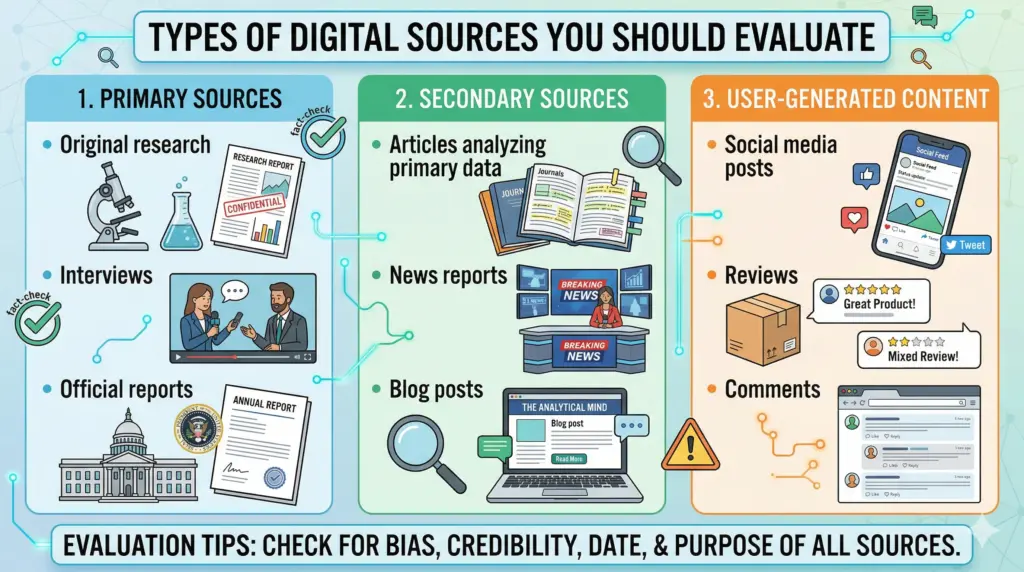
Before verifying, understand the types of sources you’re dealing with:
1. Primary Sources
- Original research
- Interviews
- Official reports
2. Secondary Sources
- Articles analyzing primary data
- News reports
- Blog posts
3. User-Generated Content
- Social media posts
- Reviews
- Comments
Each type requires a different level of scrutiny. how readers evaluate content online
10 Proven Ways to Verify Digital Sources
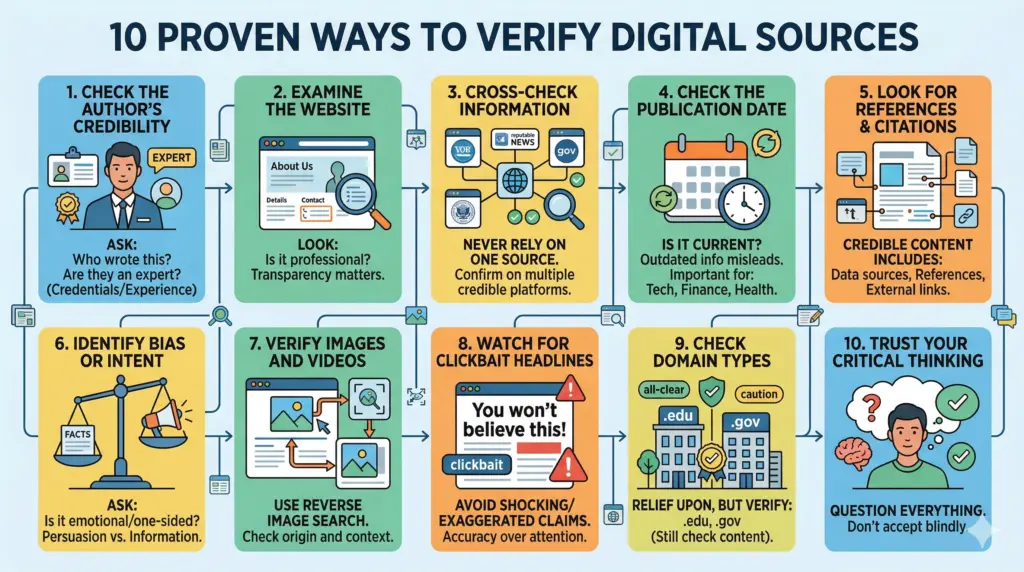
1. Check the Author’s Credibility
Always ask:
- Who wrote this?
- Are they an expert in the field?
- Do they have credentials or experience?
Reliable content usually comes from qualified professionals or trusted organizations.
2. Examine the Website or Platform
Look at the website carefully:
- Is it professional?
- Does it have an “About” page?
- Are contact details available?
Suspicious websites often lack transparency.
3. Cross-Check Information
Never rely on a single source.
Search for the same information on multiple platforms.
If multiple credible sources confirm it, it’s more likely to be true.
4. Check the Publication Date
Outdated information can be misleading.
Always check:
- When was it published?
- Has it been updated?
Especially important for:
- Technology
- Finance
- Health
5. Look for References and Citations
Credible articles often include:
- Data sources
- References
- External links
If an article has no sources, be cautious.
6. Identify Bias or Intent
Ask yourself:
- Is this trying to inform or persuade?
- Is there a hidden agenda?
- Is it overly emotional or one-sided?
Bias can distort facts.
7. Verify Images and Videos
Visual content can be manipulated.
Use reverse image search tools to check:
- Where the image originated
- Whether it’s used in a different context
8. Watch for Clickbait Headlines
If a headline sounds too shocking or exaggerated, it probably is.
Examples:
- “You won’t believe this…”
- “This changes everything…”
Clickbait often sacrifices accuracy for attention.
9. Check Domain Types
Some domains are generally more reliable:
- .edu (educational institutions)
- .gov (government sites)
But remember:
Even these should still be verified.
10. Trust Your Critical Thinking
If something feels off, it probably is.
Don’t accept information blindly—question it.
Real-Life Example: Spotting Fake vs Real Information
Imagine you read:
👉 “A new app guarantees you can earn ₹10,000 daily with zero effort.”
Red flags:
- Unrealistic claim
- No source
- No proof
- Emotional appeal
Now compare with a credible article:
👉 “Study shows average freelancers earn ₹500–₹2000 per day depending on skill.”
Why it’s credible:
- Realistic
- Data-backed
- Balanced
Common Mistakes People Make
Avoid these:
- Trusting viral posts without checking
- Believing screenshots as proof
- Ignoring publication dates
- Relying on a single source
- Confusing opinion with fact
Tools to Help Verify Digital Sources
Here are some helpful tools:
- Google Reverse Image Search
- Fact-checking websites
- Plagiarism checkers
- Domain lookup tools
Using tools adds an extra layer of verification.
How Verifying Sources Helps Your SEO & Authority
If you run a blog (like minearticle.com), verifying sources helps you:
- Build trust with readers
- Improve E-E-A-T (Experience, Expertise, Authority, Trustworthiness)
- Rank higher on Google
- Reduce misinformation
Google favors accurate, reliable content.
Quick Checklist for Verifying Digital Sources
Before trusting any content, ask:
✔ Who is the author?
✔ Is the website credible?
✔ Are there references?
✔ Is the information recent?
✔ Can I verify it elsewhere?
If the answer is “yes” to most—you’re on safe ground.
Future of Digital Information Verification
With AI and automation growing, verifying sources will become even more important.
Trends include:
- AI-generated content detection
- Advanced fact-checking tools
- Real-time verification systems
The future belongs to those who can identify truth in a sea of information.
In a world overflowing with information, the real skill is not just consuming content—but understanding what to trust.
Verifying digital sources is a habit.
And like any habit, it gets better with practice.
Start today:
- Question what you read
- Cross-check information
- Think critically
Because in the digital age, wisdom isn’t just found—it’s mined.
Frequently Asked Questions (FAQ)
1. What does verifying digital sources mean?
It means checking if online information is accurate, credible, and trustworthy before using or sharing it.
2. Why is it important to verify online information?
To avoid spreading misinformation, making wrong decisions, and damaging credibility.
3. How can I check if a source is reliable?
Check the author, website credibility, references, and cross-verify with other sources.
4. What are the best tools for verification?
Google Reverse Image Search, fact-checking websites, and plagiarism tools.
5. Can social media be trusted as a source?
Not always. Social media content should always be verified before trusting or sharing.
6. What is a credible source?
A credible source is one that is accurate, unbiased, well-researched, and comes from a trusted author or organization.
7. How does verification help bloggers?
It improves trust, SEO rankings, and authority, making content more reliable.
